
More than Nostalgia
The Lost Soul of Old Minecraft

Preface - Why Does it Matter?
I would like to start this article with the following: my intent is not simply to nostalgia-bait, or prattle on about how new Minecraft is just so much worse in every way or whatever. I will admit that if you exclusively play older versions, you could miss out on some interesting features added over the years. That’s part of why I’m making this article- I actually care about the future of the game.
However, I am constantly annoyed by the dismissive attitude taken by the community whenever players raise (often valid) criticisms of newer versions, or when someone says they prefer something from an older version such as world generation or textures or even just the simplicity. The common response is often a combination of the following:
“You’re just blinded by nostalgia, the newer version is better”
“You can just play older versions or mod [x] feature out”
“Why do you care so much? It’s not that deep”
Responses like these miss the point of the criticisms in the first place. Sure, it’s true that you can modify the game however you like to fit your preferences, and it’s a feature I’m glad still exists and hopefully always will. But these players care about the identity and perception of the game. They don’t just want to enjoy their favorite version, they want others to experience what they like about it as well. Besides, given the fact that they haven’t supported such options on Bedrock Edition (where about 90% of the player-base is), I get the feeling that it’s something Microsoft begrudgingly has to accept about Java Edition for the sake of pleasing players.
The point of this article is not to berate players for not playing the version I like; I enjoy aspects of both classic and modern Minecraft, and I think it’s good to have a wide range of options. Instead, I would like to analyze the specifics of how and why: what people (myself included) actually like about older versions, and how Mojang could stand to improve Minecraft in the future by acknowledging and recreating what they got right in the past.
Surely if it was just fleeting nostalgia, players would get bored after a few hours and go back to newer versions. So why is there still so much love for older versions? Why are there still sub-communities of Beta or early Release or even Indev Minecraft players, including people without nostalgia who have never even touched those versions until recently?
I. Vision
It isn’t exactly hidden knowledge that Minecraft is a game about creativity. Player expression has always been at the core of the game, and that will probably never change. However, many longtime players feel that something about newer additions to the game weaken the core experience. Are they simply blinded by nostalgia? Or has Minecraft truly declined in some ways? Between corporate meddling, feature bloat, and an overall shift in tone, Minecraft is undoubtedly turning into a different, and in certain ways a worse game.
So what did these old players like about Minecraft to begin with? Originally, Minecraft wasn’t just about the player building things, but also overcoming the game’s obstacles in order to impose their vision on the world. While this still exists to an extent in modern Minecraft due to the core gameplay, it seems like this detail has gotten more buried as the updates roll by. Modern Minecraft has a friendlier atmosphere than older versions, adds implicit gameplay rules, and places a greater emphasis on having a concrete “lore.” And yet, by adding all this, Mojang have taken away a significant part of the initial appeal. Perhaps the simplest way this shift could be described is that the game is no longer about the player’s world, as much as it’s now about the world the player is in.
It is difficult to pinpoint when exactly this shift started, and that answer may vary from person to person. But a few controversial updates come to mind:
2011: The Adventure Update (Beta 1.8 & Release 1.0):
The game became geared more towards creative expression than challenging survival, likely the main reason for the game’s massive growth in popularity during this time. A flawed, but perhaps necessary step for the game’s success.

2016: The Combat Update (Release 1.9):
Changed the combat to be slower and more defensive, adding shields and attack cool-down. Was largely criticized for being unbalanced, such as how axes deal equal or more damage than a diamond sword. Version 1.9 was also the first major content update since Microsoft’s buyout of Mojang, and the game was declining in popularity during this time.
2019: Village and Pillage (Release 1.14):
Redesigned nearly every texture in the game, as well as villages and trading. First update to fully drop support for Legacy Console Edition. Took place around the “Revival Era” of Minecraft.

2021: Caves and Cliffs (Release 1.17 & 1.18):
Drastically overhauled Overworld generation to have more slopes, making terraforming more necessary for building. New biome-specific music tracks for the Overworld were added, making C418’s soundtrack play less often.
II. Is More Really Better?
The more I play older games such as 8 bit or 16 bit titles, the more I appreciate the concept of “tightly designed” games. These are games which use a very limited set of objects, but combine and reuse them in unique ways to keep the experience interesting, without wasting space on any extra elements. For older games, hardware limitations made such a design approach utterly necessary for a good game. Developers were pushed to work around those limitations in order to innovate, creating more with less.
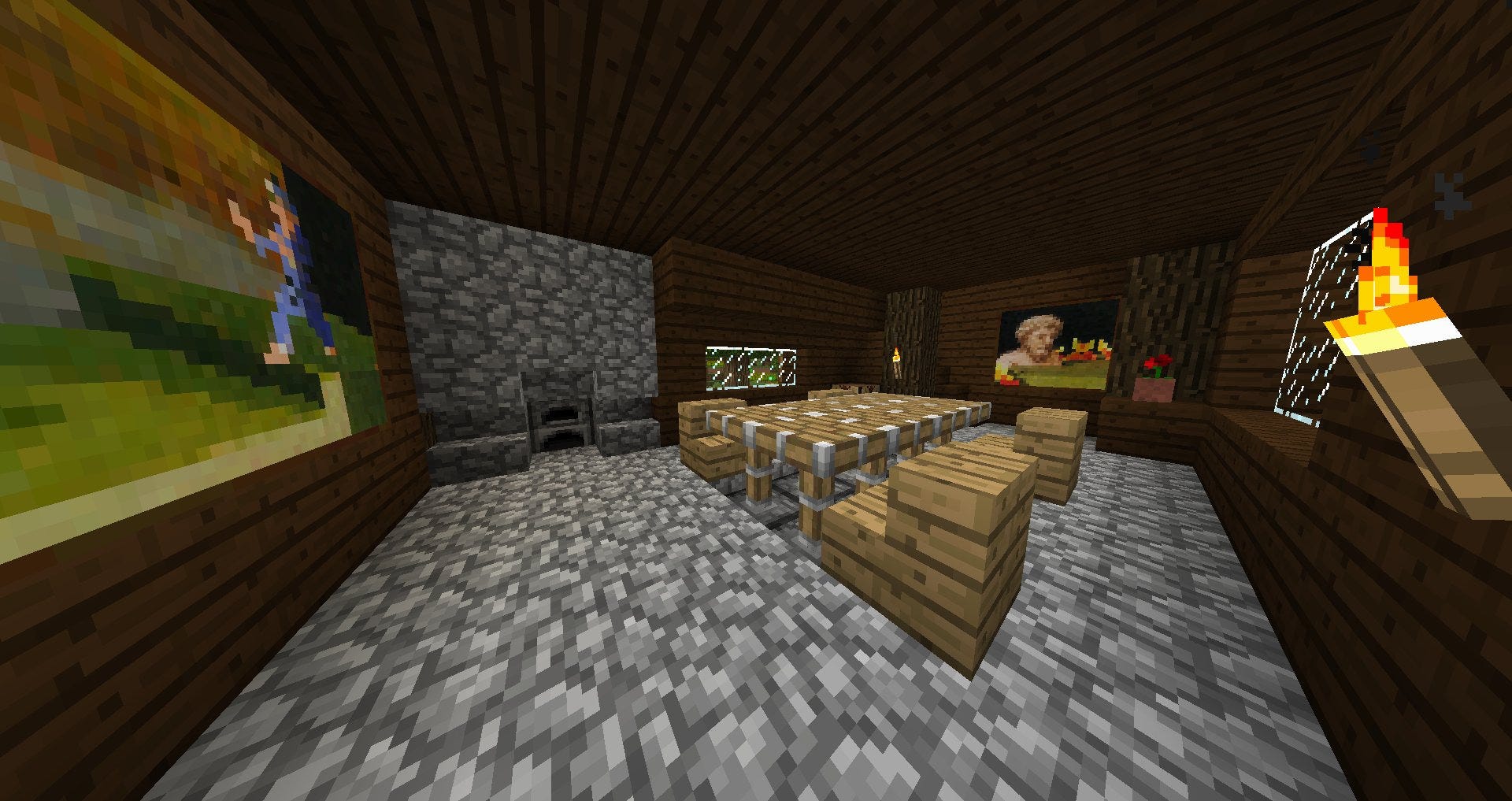
If there is one thing that sets building in old Minecraft apart from newer versions, it’s that players were challenged to do more with less, to make something unique with a limited block palette. To some, this statement may sound counterintuitive. How would having less blocks create more options? Let’s view an example of what I call the “campfire problem.”
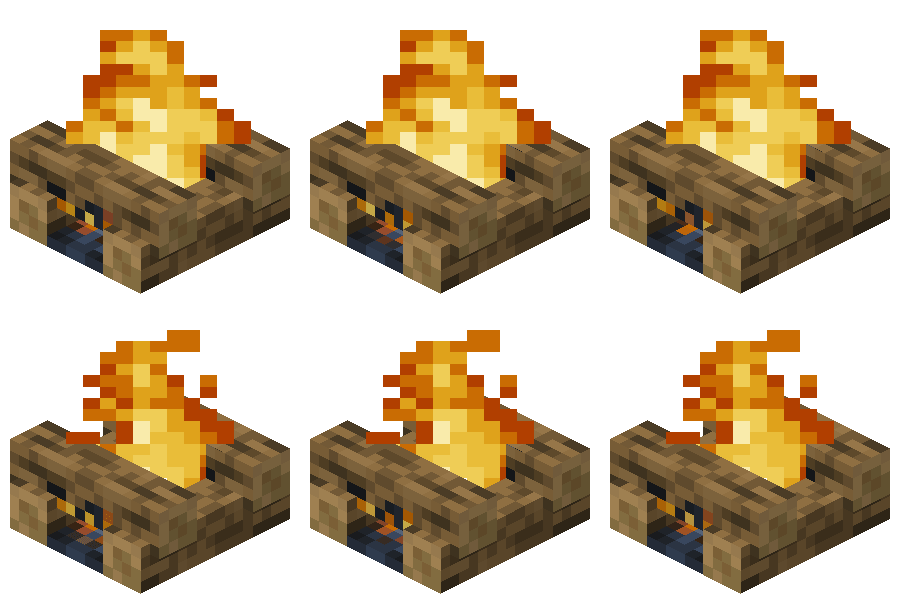
In update 1.14: Village and Pillage, a decorative campfire block was added to the game, with the ability to cook food similarly to the furnace, but without the fuel cost. Notice how redundant this block is; in both gameplay and aesthetics, it is best described by the attributes of other blocks. The furnace already exists, and it negates the purpose of cheap fuel sources. Aesthetically speaking, fire on its own has existed in the game for years and could already be used with other blocks to make campfires.
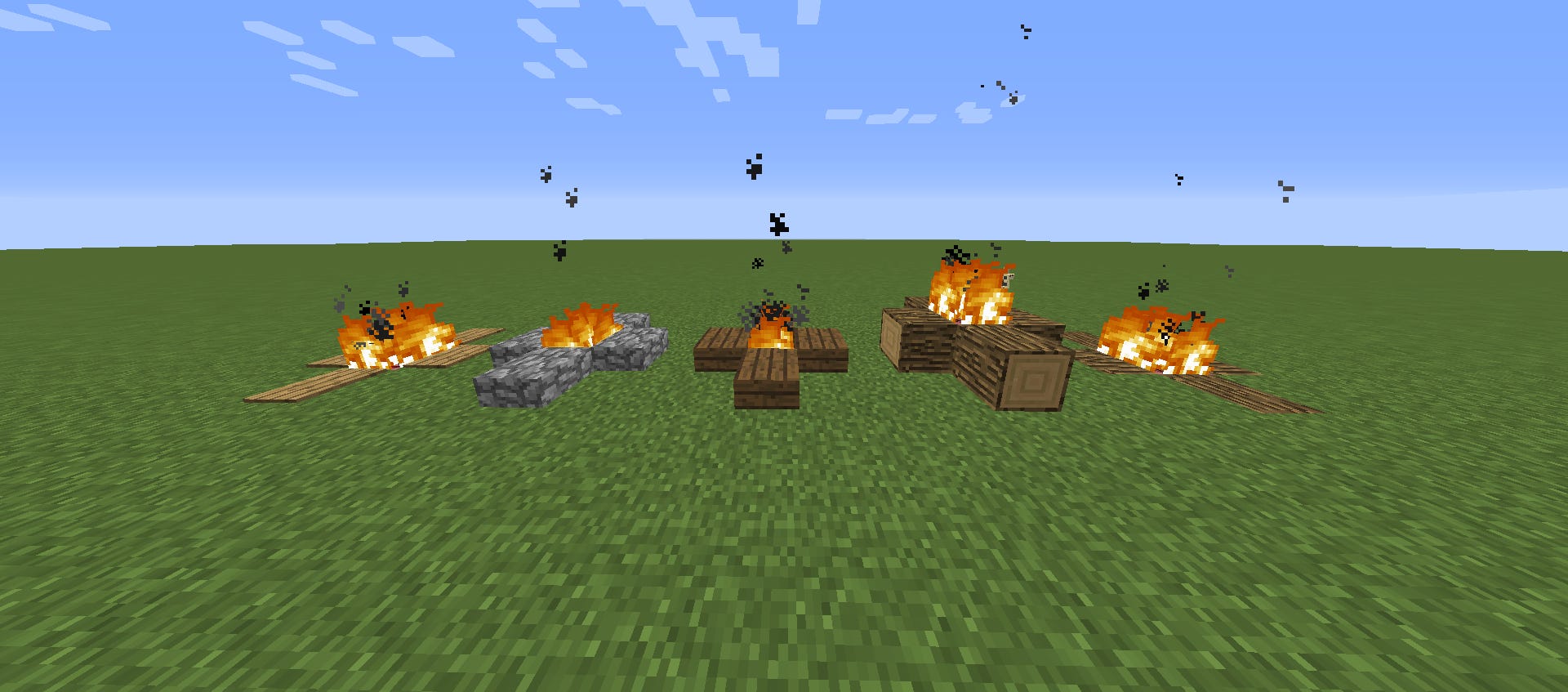
One may argue that there’s nothing wrong with the inclusion of the campfire block, since nothing stops the player from still making old campfire designs such as the ones pictured above. However, why should they? The existence of the campfire block removes the novelty of these designs, and a player using them instead of the campfire block would appear unaware. What was once a clever trick to get around limitations now looks wrong when said limitations are removed. By creating a standard, easy solution to a design problem, the campfire block removes the interesting challenge of solving that problem in the first place, implicitly robbing the player of creative choice. To use anything but the campfire block would be making a campfire “the wrong way”.
Campfires also do not spread fire or burn items, which takes away from the design challenge of incorporating fire into a build without damaging flammable parts. An open fire should not be “safe” to put near any flammable material- it’s inconsistent with how fire functions throughout the rest of the game.
In fairness to the campfire, it still has its own unique uses as a block, though in its secondary functions rather than primary ones. It produces more smoke than a regular fire, allowing it to be used as an early game beacon or to make builds like hot springs or volcanoes look more active. Placing it on top of a hay bale produces even more smoke, adding a new item interaction. The fire itself can also be put out, so that the logs at the base could be used to make bridges or other makeshift looking platforms. These are fine enough features that provide new opportunities, but those could’ve been incorporated into existing features, rather than narrowing their purpose.
Let’s imagine a more extreme example in a hypothetical. Suppose that in a new update, Mojang were to add chairs that could be sat in, as well as tables on which food or other items could be placed. Unless the chairs and tables are simply ugly, every possible chair or table design with existing blocks is made obsolete. Again, this would deprive the player of creative choice by adding a “right way” to make those things.
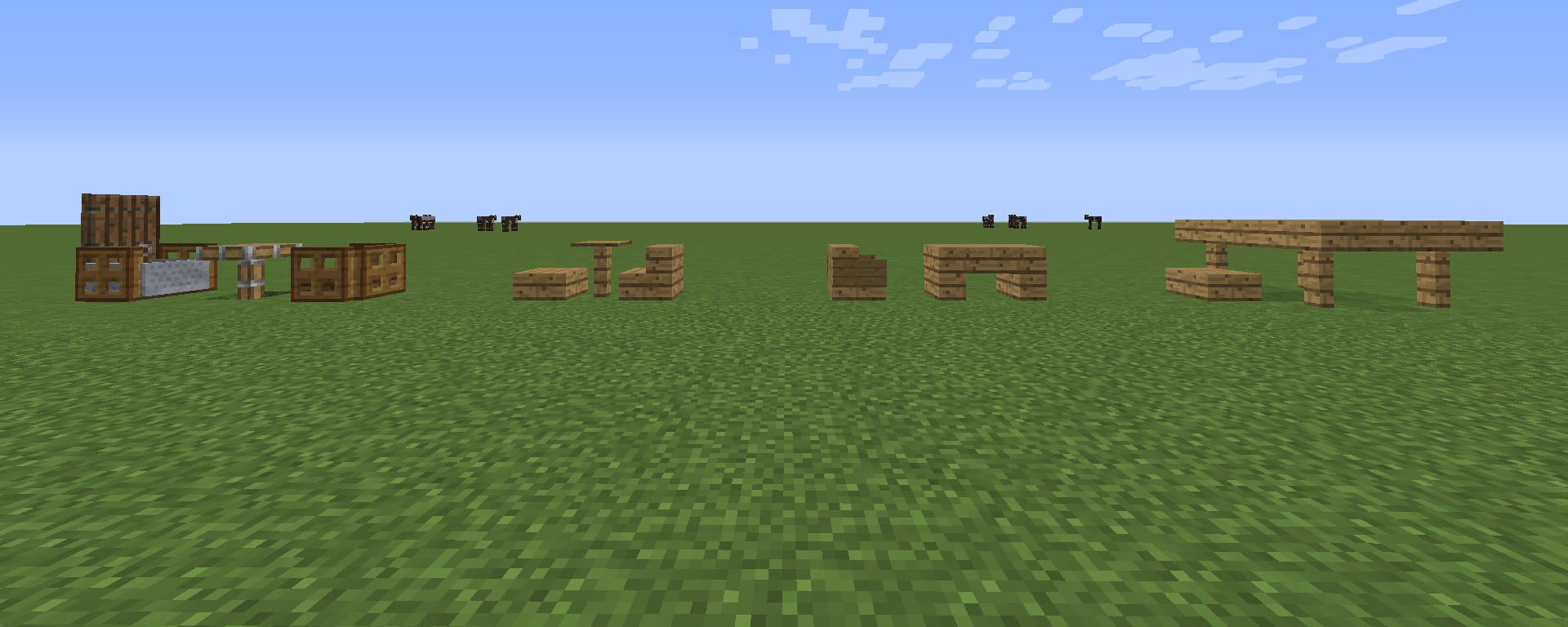
If such an addition were made, it would remove some decorative potential from all of the blocks pictured. Stairs or slabs would no longer make sense as chairs, because chairs are now their own block. A pressure plate on top of a fence or an extended piston in the ground can’t give a convincing illusion of a table when placed right next to an actual table. The other blocks that were once used for those things are now irrelevant in that aspect, narrowing the use of the player’s existing tools for the sake of adding more tools. It is a “wide and shallow” approach, as opposed to the more “narrow and deep” approach of older versions. In a game where inventory management is an increasing problem with every update, perhaps such an approach should be reconsidered.
III. Balance & Progression
Putting blocks aside, this problem of more options with narrower use is very clear with utility items. Until the recent Copper Age update, copper ore had essentially no use outside of aesthetic purposes, meaning Overworld caves were full of a block that most players don’t need. Adding Copper as its own tool tier was a step in the right direction and helps the early game progression, but the ore once again becomes useless when the player has a steady quantity of iron to replace it. With the exception of niche redstone applications, amethyst is also a fairly useless aesthetic ore that takes up a lot of space. Unless you can’t use Optifine for whatever reason, don’t dare suggest with a straight face that the spyglass is useful.
One might argue that quartz also has this problem, but that because of nostalgia bias people will ignore that. However, quartz is exclusive to the nether and easily ignorable, whereas copper and amethyst take up a lot of space in the Overworld. The player is probably not going to end up with large amounts of quartz unless they’re intending to build something with it. (Though it could be interesting to see more uses for quartz.)
In an attempt to enrich the game with more variety, Mojang has added several alternatives to standard gear, but most of them become niche once the initial hype dies down, often due to how situational they are.
The trident was added as a throwable melee weapon, but when enchantments are considered it’s outclassed by the classic sword and bow combo, which is far easier to obtain anyway. The trident is best used as a mobility tool with the Riptide enchantment, allowing faster travel in water or rain. Useful, but still situational.
The crossbow is in a similar situation. While certainly not as rare as the trident, it’s still slightly more expensive than the bow, yet worse with max enchantments. The faster fire of an enchanted crossbow is simply not a worth the tradeoff for the higher damage, infinite arrows and other strengths of an enchanted bow.
The mace is perhaps the most situational weapon in the game, dealing potentially infinite maximum damage, but requiring falling from high up in order to deal such damage. Hypothetically it’s the strongest weapon, but it requires strange aerial tactics to get real use out of. Obtaining a heavy core to craft a mace is extremely luck based, even more so than the trident, since a player may need to fully clear several trial chambers before getting lucky enough to earn one. It can no doubt be a powerful PVP tool, but it’s debatable whether it’s really worth the effort in a survival world.
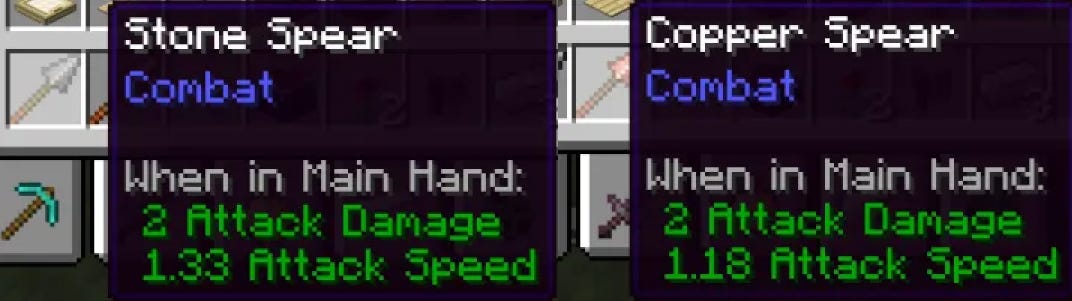
So in this sense, I suppose the newly added spear is a good step in the right direction. It’s cheap, made from common materials, and provides the unique benefit of extra range. My only complaints so far are that the animations are too smooth for the game’s aesthetic, hitboxes feel janky to get used to, and for some reason they made the stone spear objectively better than copper.
However, on the other extreme, there are things which are too useful for the effort required to get them. Depending on who you ask, this can arguably be traced as far back to the addition of sprinting making mobs easier to escape from, if not even earlier with beds skipping the night. While I think these features were beneficial, I could see the argument for them being unbalanced, since the game wasn’t initially designed with them in mind nor fully balanced accordingly.
When horses were added, the minecart railway was made obsolete due to its inferior speed and much higher cost to set up. Both of these were made further obsolete by the addition of firework boosting to elytras, enabling instant flight at far greater speeds than essentially every other main method of transport.
Over the years, Minecraft has messed up its sense of balance between time investment and reward. You could collect resources and build a railway between locations, but that would be a waste of time and resources if players already have easy access to horses or elytras. As a result, more pragmatic players are steered away from an interesting outlet of creativity.
Admittedly, this is partially a problem related to the player’s mindset, but I’d argue that newer versions lend themselves more to that sort of min-max mindset.
And while we’re on that topic…
Maximizing gear is an extremely monotonous task, and while that has been the case ever since enchanting was added, it has only become more clear as the need for strong gear has increased.
Currently, the player’s best options for getting good enchantments are either:
AFK farm XP for hours, repeatedly add enchantments with the enchanting table and re-roll with the grindstone.
Capture librarian Villagers in little boxes, break and replace their lecterns until they sell the desired enchantments, then apply them on an anvil.
Both of the above.
When the best way to reach maximum power involves leaving the game on idle, repeating basic monotonous tasks, gambling, and/or NPC slavery, maybe it’s time to question if it’s worth the time and effort, let alone if it’s even fun.
Before enchanting was added, getting the best tools required the player to merely mine the best material, and then use it to craft tools. This provided a simple but strong loop of resource collection and creation that literally defines the game by name.
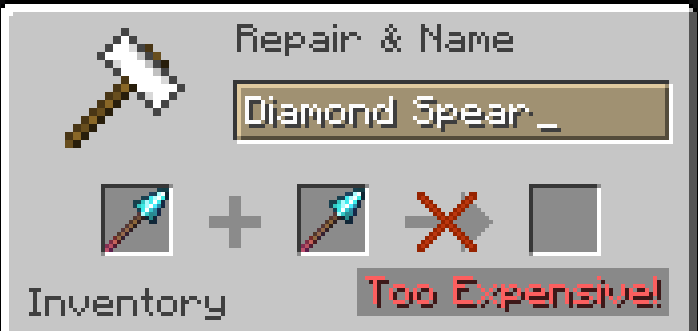
While enchanting adds a layer of depth to upgrading tools, the method for obtaining them is heavily luck based and nonsensical, distracting from that core loop. Furthermore, repairing enchanted tools on an anvil is unreasonably expensive, with XP cost skyrocketing at a literal exponential rate until it reaches a limit at which the tool is simply too expensive to repair.
While the addition of the mending enchantment in 1.9 takes away frustration from the anvil’s problems, it feels like a band-aid solution that creates other issues. The existence of mending makes collecting extra diamonds, once the apex material of the game, now pointless outside of server currency, since they’re no longer needed to replace tools.
The new apex material, netherite, suffers from similar problems. When the Nether Update released, Mojang’s addition of a tier above diamond initially seemed like a massive change to the game, but in reality very little actually happened. Netherite armor doesn’t provide any more base defense than diamond armor, only increased armor toughness (protection from stronger hits) and knockback resistance. Mining tools receive a minuscule increase in speed, and a netherite sword has a near inconsequential damage increase compared to diamond. And of course, the higher durability of these tools is completely irrelevant with mending applied.
The only significant advantage netherite has over diamond is that it won’t burn when dropped in fire or lava, and that the armor usually looks cooler with armor trims applied. In retrospect, all that netherite really added was another thing to make players spend hours grinding for.
Would it not have made more sense to simply tweak the ridiculous anvil price scaling? Or make the enchanting table’s output more than pure RNG? Unfortunately, Minecraft is designed in such a way that players become extremely attached to their tools due to absolute slog needed to make them. Is really it any wonder why the “2 week Minecraft phase” phenomenon exists when dying and losing tools means undoing the monotonous hours spent making them?
This may also explain why many players find the early game to be the most fun part of progression, and start over rather than sticking to one world. After the player gets iron tools and maybe a few diamonds, the progression screeches to a halt. And yet, modern versions also seem to minimize much of the existing challenge of the early game, such as the addition of beds to villages. The player can now avoid the threat of night without ever having to mine a single block.
IV. Atmosphere & Implicit Rules
The newer villages don’t just mess with the progression of the game, but the atmosphere as well. As mentioned in the introduction, the game originally was not just about players building things, but overcoming their environment in order to do so, imposing their vision on the world. By making naturally generating structures, particularly villages, too advanced and rewarding, it softens this challenge. It reduces the role of the player from a distinctly creative and intelligent being to just another resident in the world.
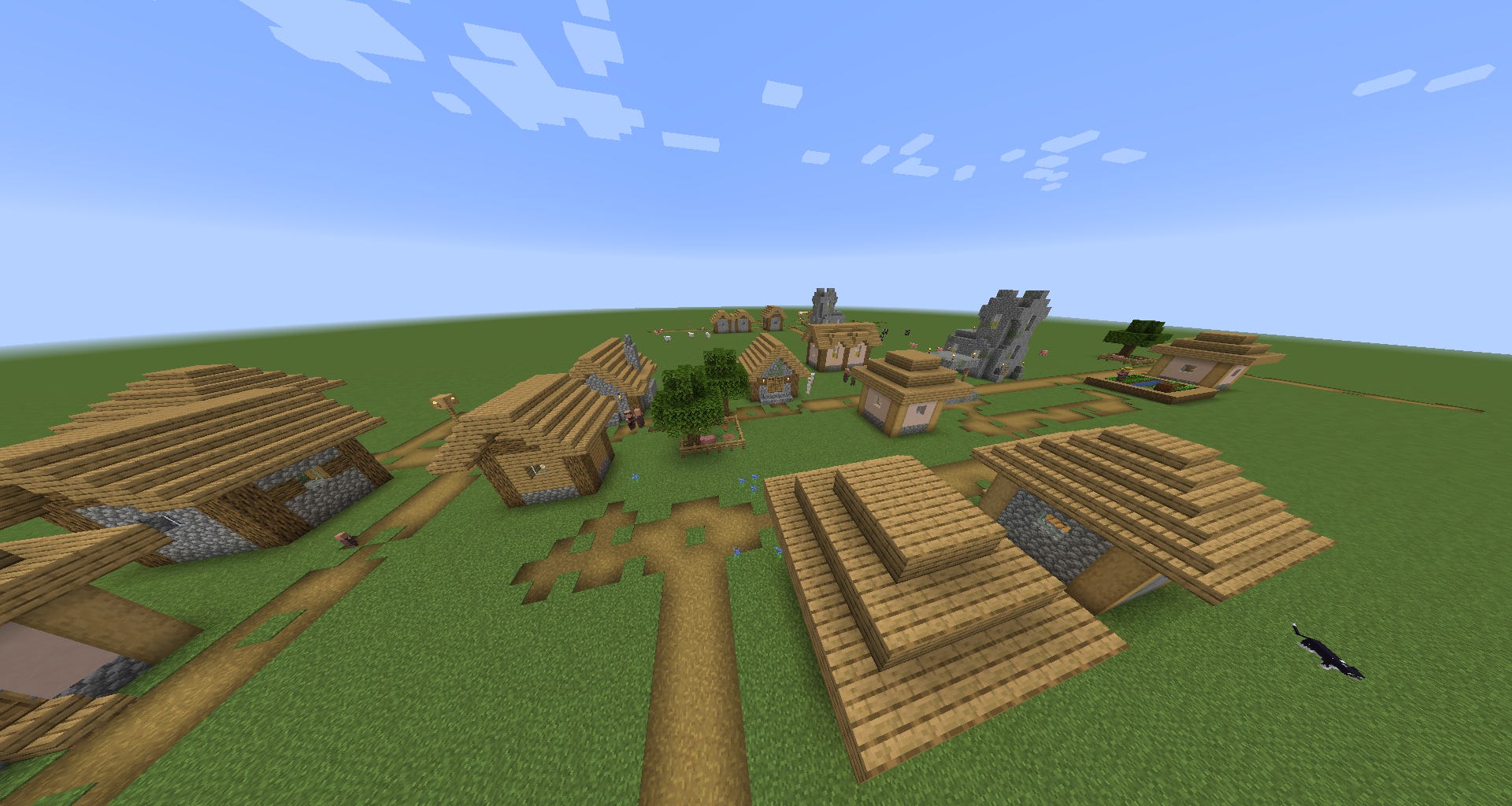
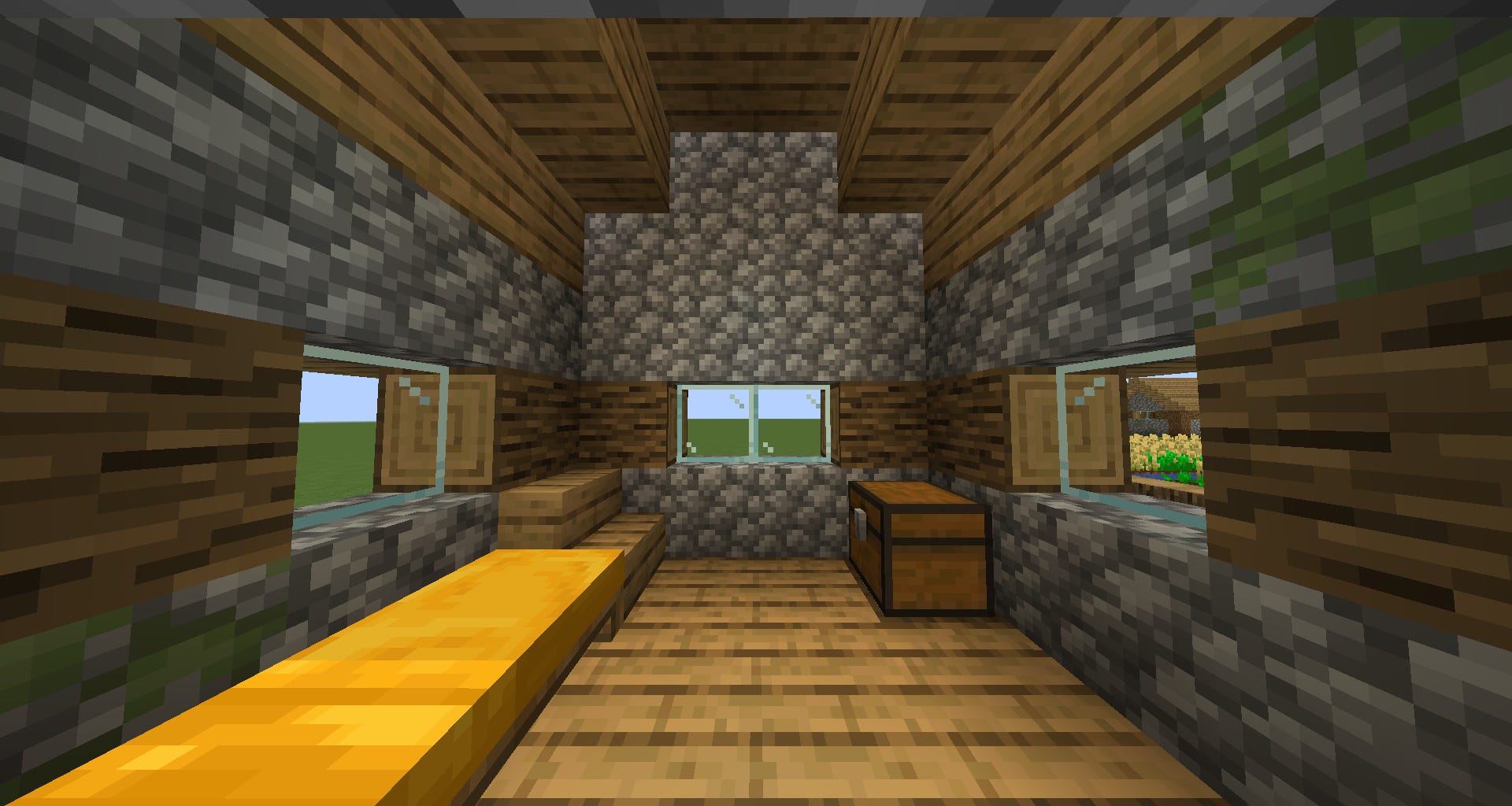
Let’s examine old villages for a bit. They’re extremely simple, even a bit primitive. Most houses have dim to no lighting, no doors, dirt floors, or misshapen roofs. They may showcase classic building techniques such as stairs in roofs or logs in corners, but they’re practically begging to be renovated by the player. In that sense, they’re like templates for houses, a starting point to give the player ideas rather than a finished product. In many cases, it’s a necessity for the player to renovate the village to some extent if they wish to keep the villagers alive.
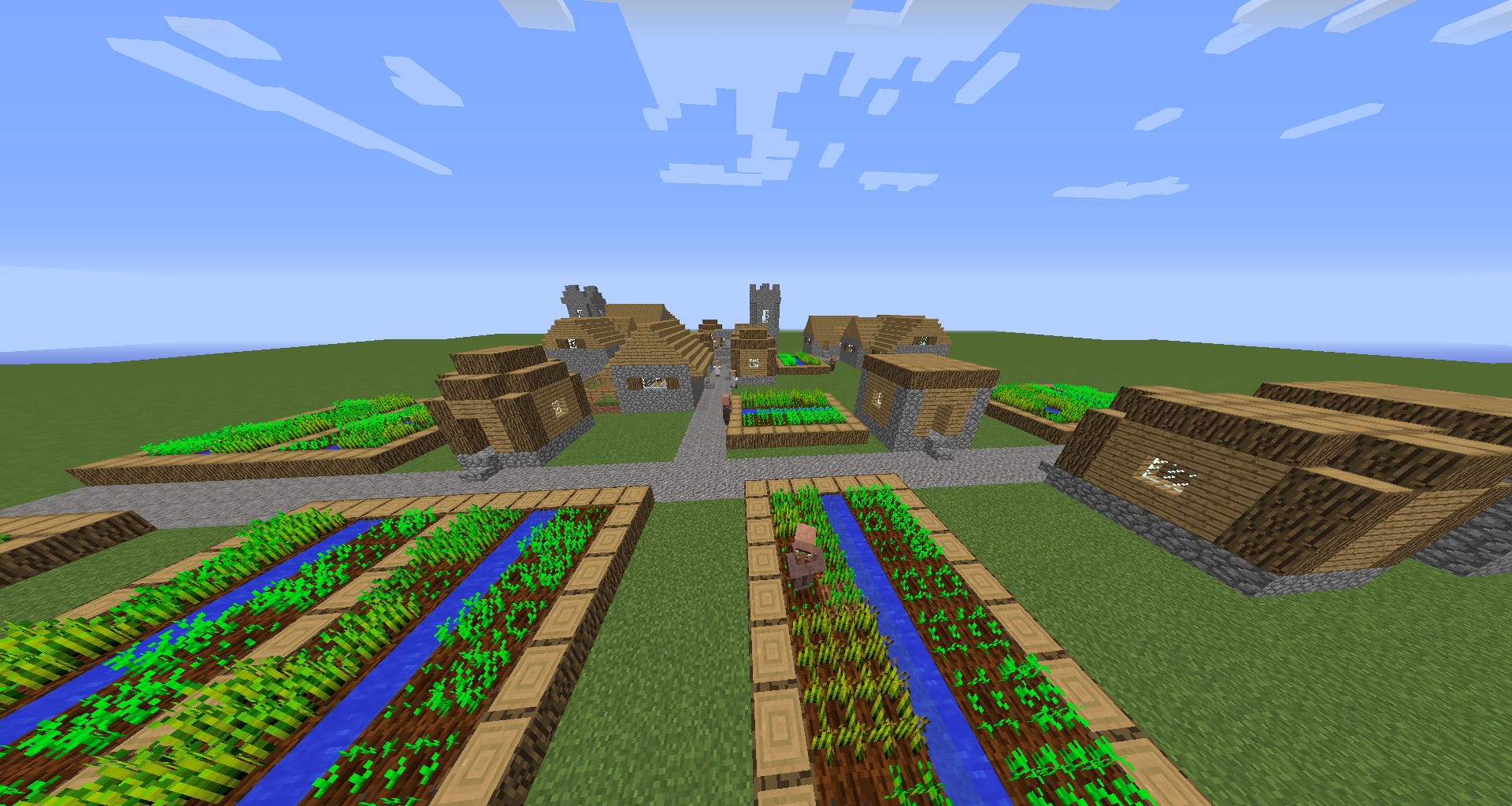
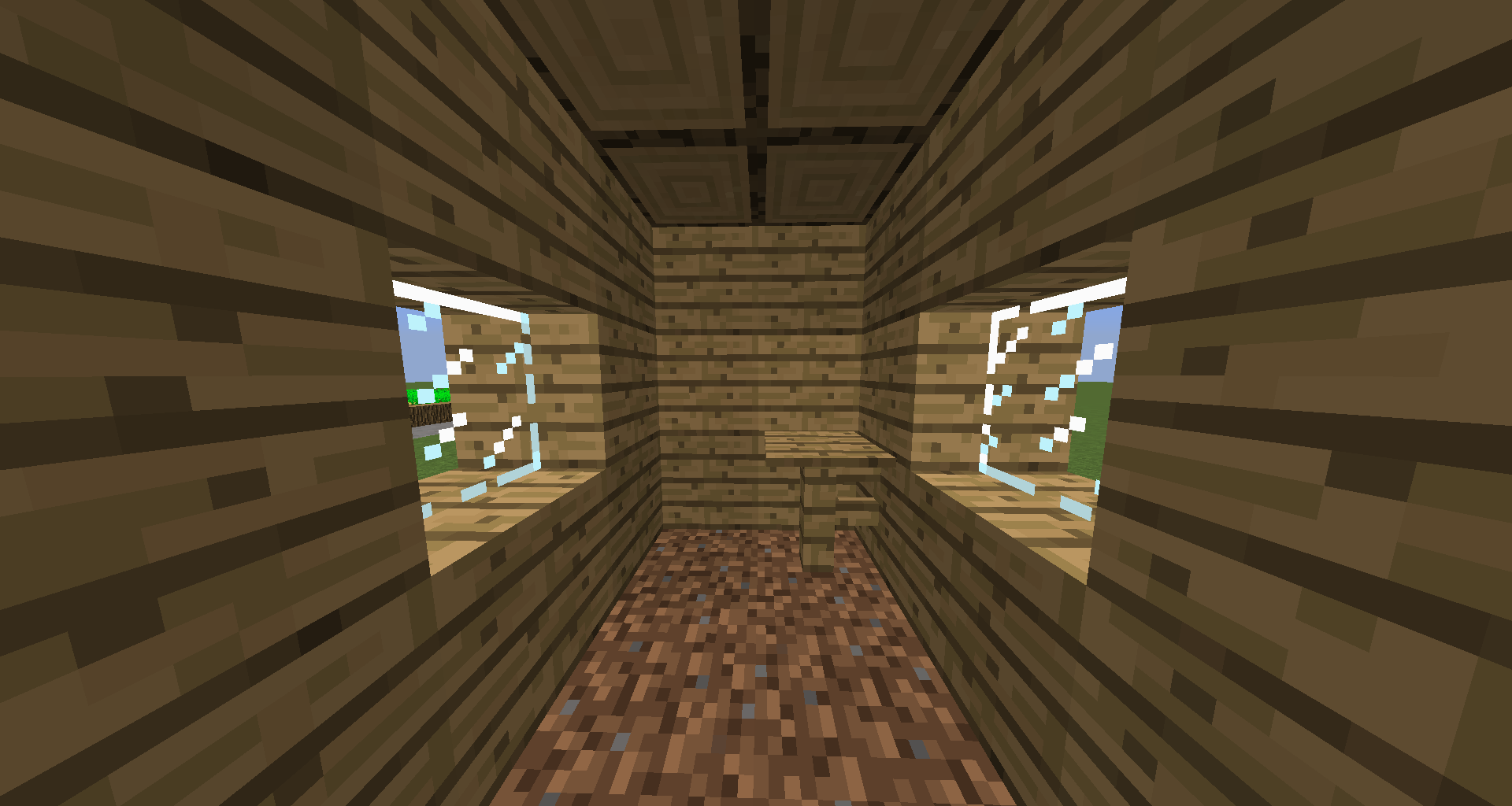
Now, contrast this with how villages have generated since 1.14. All houses have doors and sufficient lighting, functioning as fully pre-built starter bases. Zero changes need to be made in order to meet the needs of villagers or even players, except maybe a furnace. If older villages were a template, newer villages are that template completed by the game before the player can. This is the campfire problem, but on a larger scale; the design challenge of having to renovate the village is taken away from the player’s hands.
One could even argue that the completeness of new villages implicitly nudges the player to conform to the building style of their surroundings, rather than the other way around.
Modern Minecraft is full of implicit rules, such as phantoms spawning when the player doesn’t sleep for 3 days, or players being encouraged to avoid the warden rather than kill it, since it doesn’t drop anything useful when killed.
This leads one to wonder: whatever happened to the old motto from the game’s release trailer?
Sure, no one can tell you to sleep at least every 3 nights, but phantoms get annoying if you don’t disable them. No one can tell you that you cannot use a different building style than the nearby village, but it would look out of place if you did. No one can tell you that you cannot kill the warden, but you get nothing worthwhile out of it. No one can tell you that you cannot build a railway between bases, but there’s no incentive if you already have an elytra.
Well, no one can tell you that you only like an older version because of nostalgia.
In old Minecraft, not only is the player tasked with imposing their vision on the world through their actions and creations, but also through their perception of it. Many early mob species original to the game were rather ambiguous about what they actually were; what exactly do we know about the creeper, other than that it is a green thing that explodes? Is it an insect of sorts? Is it part plant? Is it even organic? The game leaves the player to fill in those blanks.
As VT points out in a thread, the older aesthetic of Minecraft presents a world with many familiar elements from the real world, but distorted in an ambiguous, dreamlike way. In contrast, much of the aesthetic of modern Minecraft feels overly self referential.

When they aren’t just making biome variants of older mobs or adding specific real world species, many newer mobs, such as the Illagers, can’t really make sense in any other context except Minecraft. They feel like they’re made to spruce up the “Minecraft world” and fit neatly into existing “lore”, rather than to serve as broad archetypes like older mobs. The existence of Illagers as a warring faction to the Villagers makes the Minecraft world feel more self contained and independent from the player, creating a different atmosphere from early versions.
This problem becomes even more apparent when we take structures into account. Old structures had more of an air of mystery to their origin due to being gameplay focused, whereas newer ones take more consideration into having concrete lore. As mentioned with villages, early structures were more primitive, whereas newer structures like pillager outposts or piglin bastions are fairly advanced and active. Even when looking at just “abandoned” structures, it seems as though over time the game has gone from merely hinting at pre-player civilizations with dungeons or strongholds, to practically telling it outright with archaeology ruins.
To be fair, it's difficult to fault Mojang entirely for this. It makes sense that such a change would occur when a game has received near constant updates for over 16 years, and is pressured to keep doing so. After a certain point, what else can you really do but fill in the blanks that were once intentionally left empty?
V. Art Style
Perhaps one of the most needlessly contentious subjects related to old versus new Minecraft is the debate over textures. Defenders of JAPPA’s re-textures will swear up and down that new textures are clearly superior, often citing examples such as the netherrack texture.


Sure, it’s hard to deny that the new texture is much easier on the eye. But is that actually a good thing? The Nether is a Hell-like dimension, why shouldn’t it be jarring, even revolting to look at? Given its context, it’s quite clear that the original texture was never intended to be pleasant, and what’s wrong with that? Should every edge, every abrasive element of a work be smoothed down until it’s no longer interesting? The original texture for netherrack, or “bloodstone” as it was initially called, is a twisted mess. It’s rough, unwelcoming, and a bit alien. It’s probably a stone, but its appearance suggests it could also be part flesh or some other odd material. The new texture, on the other hand, is basically just a faded dark red sort of cobblestone.
If Notch wanted netherrack to just be a red cobblestone, he could have simply done that. But he intentionally overlaid bedrock’s texture on top of cobblestone’s to make it appear more messed up and hellish. If you want to argue about which one “looks prettier” then fine, the new texture is prettier. But because of that, it loses the whole point of the original.
Out of all things that should be easy on the eye, Hell is probably near the bottom of that list. Even JAPPA’s early version of the re-texture showed he understood this to an extent.
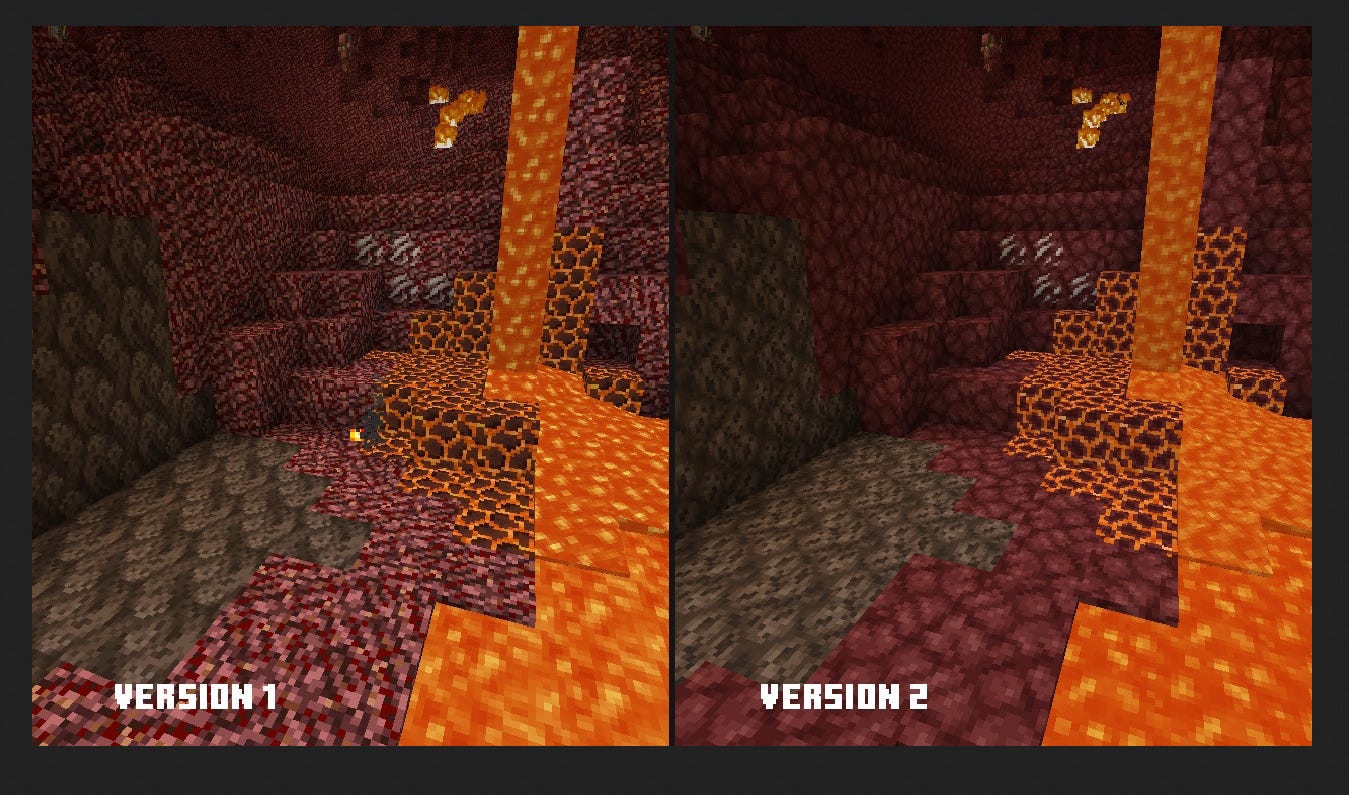
For some reason, many of the final versions of JAPPA’s textures are seemingly allergic to sharpness and contrast. Let’s compare some more textures. Here is a screenshot of a build in the newest version with default JAPPA textures:
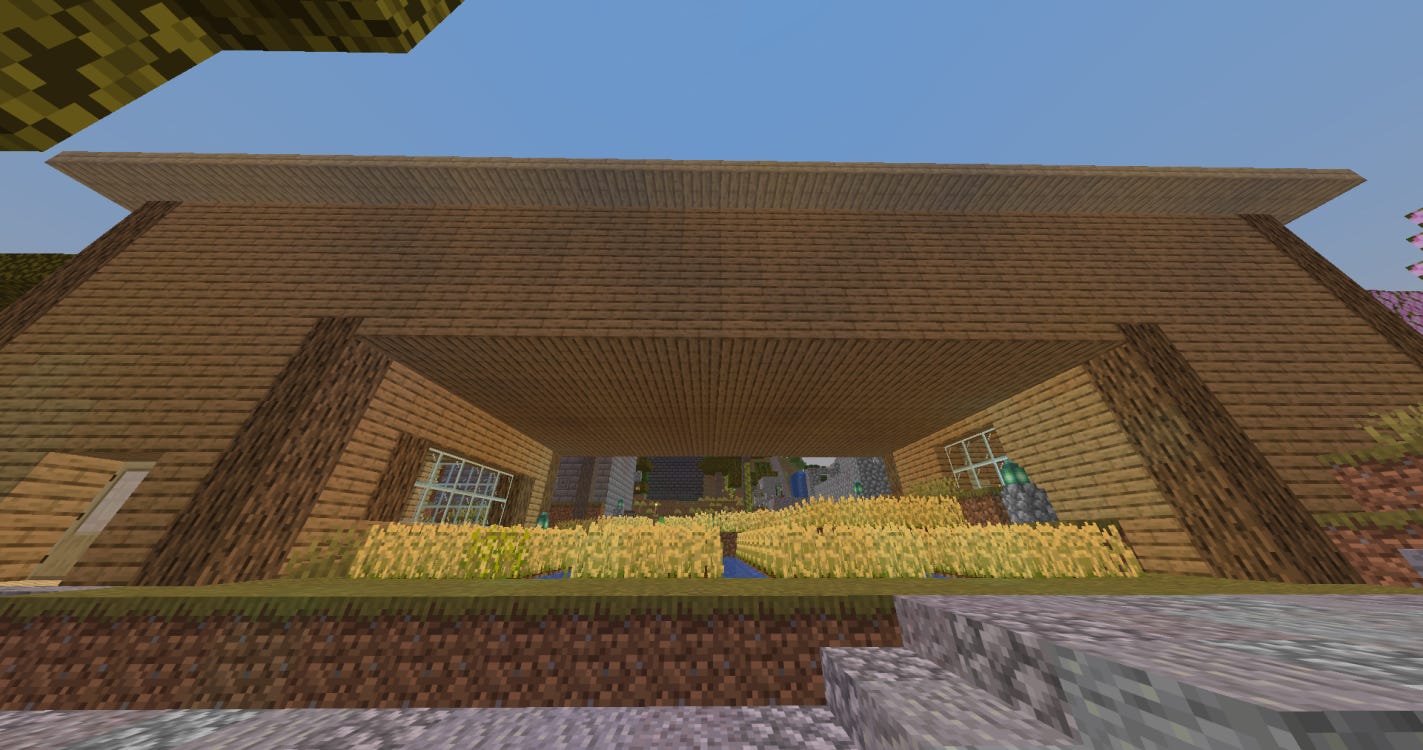
Now, here is that same build with Programmer Art enabled:
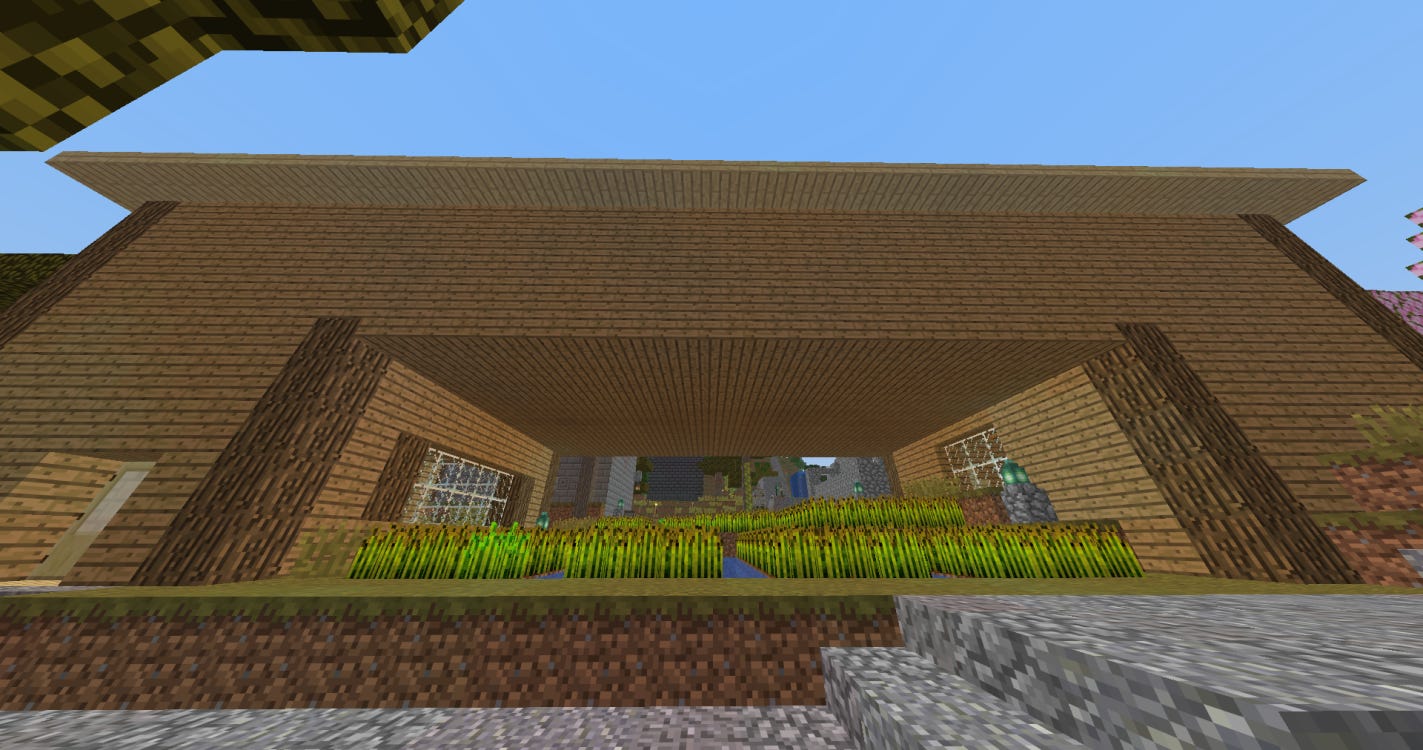
It would probably help to open the images in separate tabs and look at them more closely. Notice how much smoother, almost rubbery the new wood looks when compared to the grainy appearance of the original. Look at the almost monochromatic new wheat texture versus the mix of green, yellow and brown in the original. Compare the path on the bottom of the images- the higher contrast of the original textures give creates a stronger feeling of depth, and they tile together more naturally as a result.
JAPPA’s textures trade the charmingly crunchy look of the original art in favor of a more muted, singular color scheme. I could go on, but YouTuber Gerg already provides an excellent analysis on the game's textures. I highly recommend watching the full video after this article, because most of the arguments presented are the same ones that I would make. As he correctly points out, the main difference is that old textures actually represent the material, whereas the new ones represent a single color within a certain range.
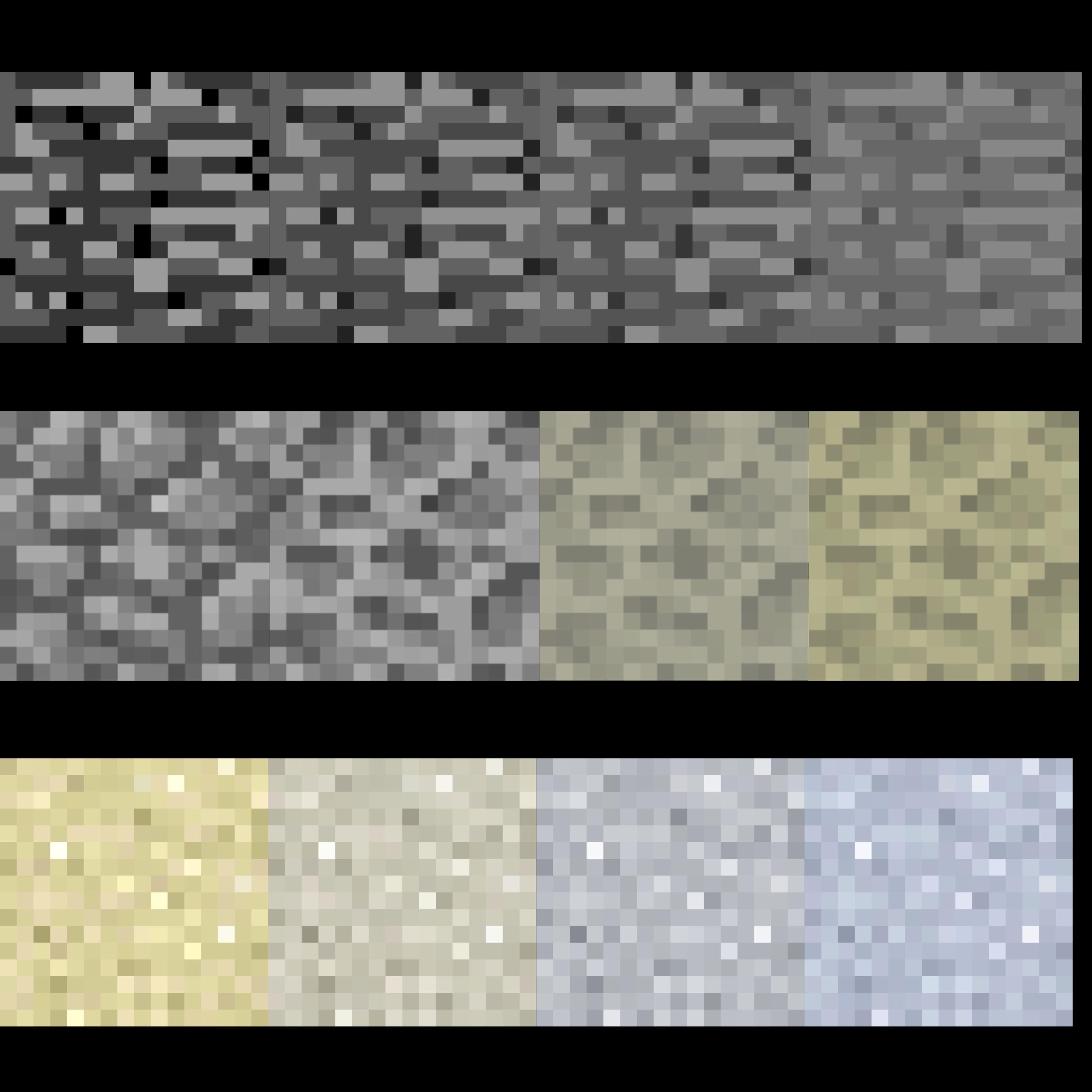
Another underappreciated aspect of the old textures is the asset reuse. A common criticism of Programmer Art is that it doesn’t feel unified- but that’s simply not true. If anything, the old art is probably more unified than the new textures due to the techniques used to make them. Notch edited, reused and combined different textures in order to create new ones, which ties in quite neatly with the concept of tight design mentioned earlier. Like old developers, Notch had to design the game’s art around certain limitations- only they weren’t hardware related. Instead, he was limited by his own abilities as a pixel artist, which prompted him to stretch his own textures thin: inverting, rotating, recoloring, creating a lot with a little. As I alluded to previously, the texture for netherrack is a combination of cobblestone and bedrock, which is itself stone darkened and given higher contrast. You can see these kinds of tricks all over the old textures if you look closely; endstone is cobblestone recolored and inverted, clay is recolored sand, terracotta is recolored stone, etc.
Mojang has also made recent efforts to change the scale of certain textures for more “pixel consistency” such as how they upscaled the Ghast.


However, I would argue that this actually creates less consistency. Most texture files in the game are around 16x16 pixels. Solid blocks are 16x16, and the player model is 16 pixels wide from shoulder to shoulder, which also applies to mobs with the same proportions such as zombies. While these things are significantly smaller than the Ghast, I think it makes sense why the Ghast’s head was 16x16, since it’s most often viewed from a distance. The extra detail isn’t really needed for such a simple design, and it has more readability from far away. Because of this, I’d argue that it matters less the absolute size of the pixels, and more the size of the textures on the model.
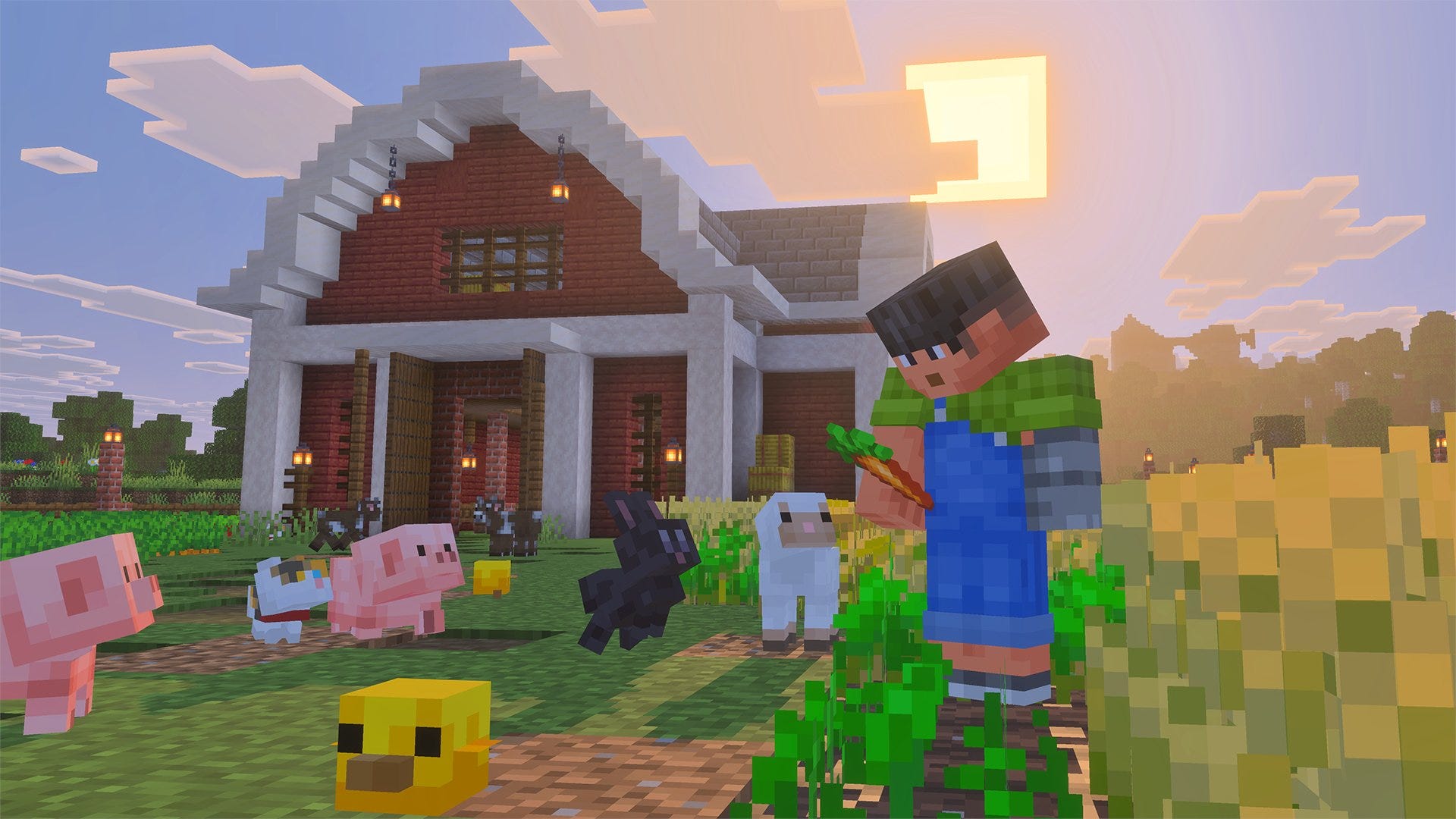
It’s for a similar reason why I don’t like the downscaling and remodels of the baby mobs, it just feels unnecessary and creates less consistency despite the intent. People criticize the old baby designs for being goofy, but that’s what gave them a certain charm. The new designs are less cute to me, because they’re cute in a boring way, much like how the new netherrack texture is boring.
Also, if we’re being honest with ourselves, this change just seems like it was made for marketing reasons. There’s not really any other reason to do this so late in the game. I have never seen a single soul ask Mojang, “Oh please, won’t you change the models for the baby animals! The pixel scaling is just oh so off and it ruins my immersion! This issue makes me less likely to recommend Minecraft™ to my friends and purchase other Minecraft™ related products in the future!”
But now that this change did happen, all of a sudden people are coming out of the wood works to say that those who prefer the goofy charm of the old models or the intentional asset reuse for tight design are supposedly nostalgia blind.
In recent years, Minecraft has felt like a game ashamed of its own past, only really accepting its legacy because it’s too iconic to fully abandon, yet not worth the actual effort to preserve. This can be seen through how broken the Programmer Art texture pack is, with Mojang not bothering to keep old models.
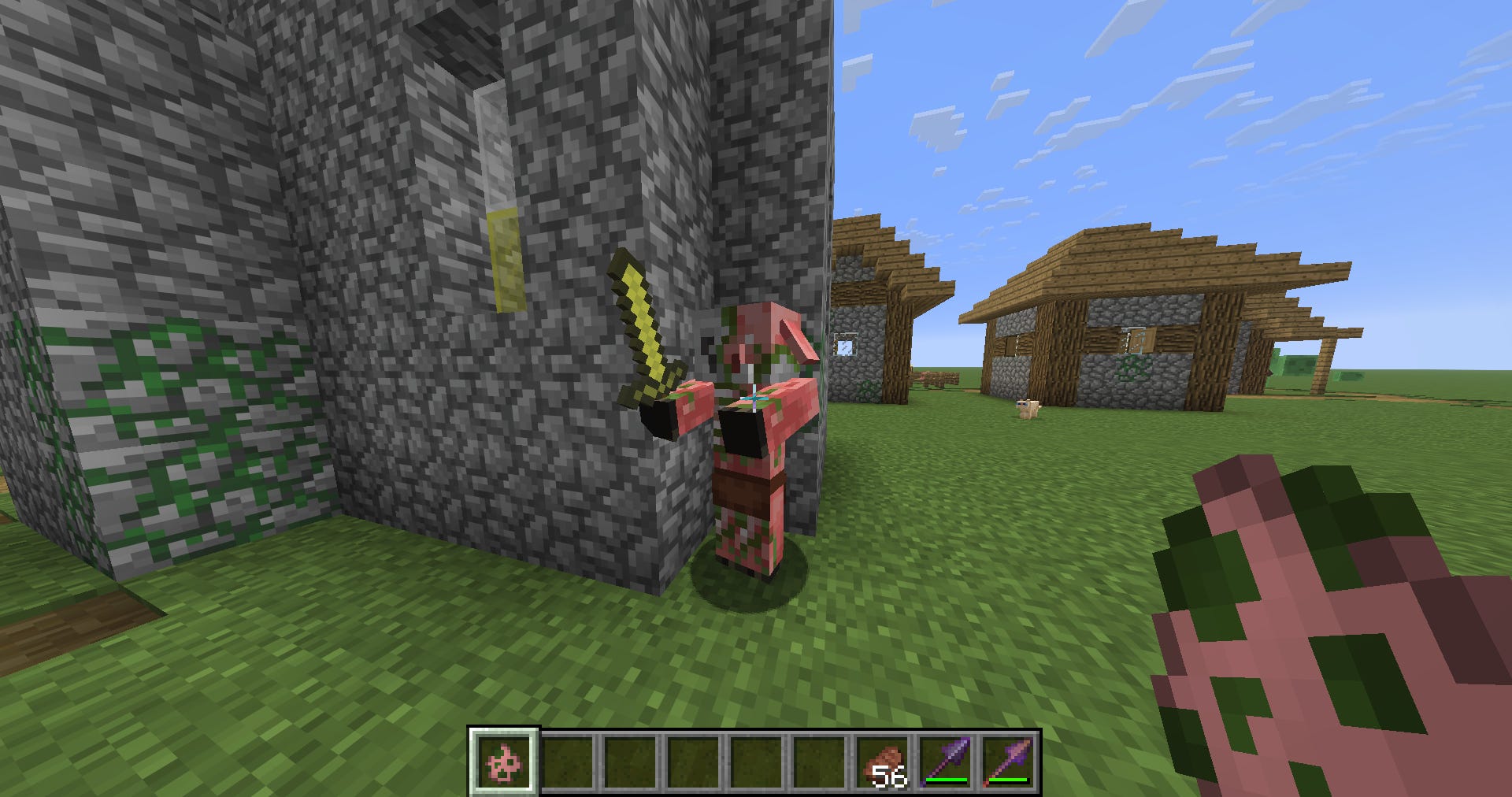
Like the Zombie Pigman, the baby animals will almost undoubtedly also keep their newer appearance even with programmer art enabled, since it is a model swap rather than a texture swap. But is it really too much to ask to simply keep those old models available for Programmer Art? Is it also such a tall order to remove the glitched Villager hoods that were never supposed to appear until the texture change? I get it, you can just use a community-made texture pack to fix all of this. But why does it have to be the job of the community to fix these issues? Do people seriously not find it ridiculous that the best selling game of all time needs its own players to clean up its mess? This should be an embarrassment to Mojang and Microsoft. They have a gazillion dollars, surely they can find or hire someone to preserve the old art style of the game. The truth is, they don’t care.
VI. Music
It’s not just the old textures that Mojang seems to no longer appreciate about the game, but the old music as well. Sure, they haven’t been removed, but they play less often to make room for new tracks from other composers. Even if the new music tracks were hypothetically better than C418’s in every way, it would still irk me how he stopped getting hired to make soundtracks because he rightfully refused to let Microsoft own his music. Every time I hear a Minecraft track from another composer, that decision from Microsoft lingers in the back of my head.
There’s a certain humbleness to C418’s original soundtrack, especially Volume Alpha, that isn’t quite present in many of the newer tracks. Ignoring the music discs, many of the original songs make use of very simple, common analog instruments such as pianos and strings, as well as relatively simple synths. C418’s music direction for the ambience intentionally avoids sounding “retro” in most cases, which creates a memorable contrast to the graphics.
On the contrary, many of the newer tracks seem to intentionally lean into the “retro” feel, making heavier use of quirky synths and bitcrushing, in addition to vibrato and similar techniques. They’re a bit more melodically complex than many of C418’s tracks, but in a way that, to me at least, seems show-offy almost.
C418 does a better job at demonstrating competence in restraint; his tracks aren’t meant to impress the player like the new tracks seem to be, but instead focus on simple, memorable melodies backed by well developed progression, particularly in harmony and rhythm.
I’m not sure I can properly explain this, but it feels like the new tracks are trying to evoke specific feelings out of the listener. They want to sound grand and emotional, whereas the old tracks felt more ambiguous, allowing the player to project their emotions depending on what’s happening in game. The old soundtrack evokes feelings of nostalgia now because of actual nostalgia, but that probably wasn’t the case back for most people back when it was first heard in game. Sometimes it sounds playful, other times adventurous, and other times wistful. That’s the genius of C418’s soundtrack, it fits for so many scenarios.
Of course, this is also due to how these tracks were meant to be implemented into the game. The original music would play at random moments and give them more meaning, due to Notch’s limited experience with sound engine programming. Meanwhile, new tracks are made to play at specific parts of the game, such as certain biomes. This is another example of what I mean when I say that old Minecraft was focused on the player’s world, while new Minecraft is about the world the player is in. The old approach is player focused, while the new approach is environment focused.
Up to this point, I’ve been mainly comparing the ambient tracks, but I also find something lacking from the new discs. C418’s disc tracks have such a variety and drastic shifts that a lot of them start to feel like multiple mini songs put into one.
Not only is this level of varied structure absent from most of the new discs, but they just don’t fit for the game’s style. I’ll concede that the discs have always been on the more experimental side, though a lot of the new ones feel like they’re specifically mimicking soundtracks of other games. For instance, Precipice by Aaron Cherof sounds more like an Undertale boss theme than an actual music disc track for Minecraft.
I wouldn’t say it’s a bad song, or even that the composers aren’t allowed take inspiration from other games, but it simply doesn’t belong. At this point though, I guess they could add Megalovania to vanilla Minecraft as a disc and whoever doesn’t like it will be scolded for not having “joy and whimsy,” which has basically become a code phrase for “lack of critical thinking.”
Conclusion - The Case of the Creeper
There’s something ironic about the mascot of a game about creation being its main destructive force. Yet despite (or perhaps because of) this, the Creeper remains the most iconic symbol of the entire game, and has understandably received very few changes since its introduction.
One of the most common talking points repeated online about modern Minecraft is that Mojang wouldn’t have added the Creeper today if it wasn’t already in the game, because it would go against their current design philosophy for the game. In fact, the current lead developer Jeb essentially confirmed in a recent video that this is true. Again, I think it’s another example of the game being ashamed of its own past.

In fairness to Jeb, Notch clarified that he agreed, saying that he was the first to consider redesigning the Creeper’s behavior, giving the rationale that random destructive events the player has no control over are “anti-fun.”
While I of course respect Notch for defending Jeb, I still disagree with this mindset and I’m glad that such changes weren’t made. To this day, some of my most distinct memories from the game are of Creepers blowing up my builds. It’s terrible at the time, but you learn to get over it and recover, maybe even build something better in its place. Perhaps from a modern game design lens the Creeper is “bad design,” but I think it teaches a valuable lesson to the player, especially younger players, that sometimes you’ll get random BS thrown at you, and it’s how you react that matters. Maybe this is why the Creeper is so iconic.
Even the Creeper’s origin unintentionally reflects this idea; Notch didn’t plan out the Creeper’s design, but instead it came about after a programming error with the Pig’s model. Because of this, to me, the Creeper represents a greater concept than just destruction. I see it as a microcosm of the original spirit of the game, the heart of Minecraft if you will. It’s an obstacle to overcome; weaken that obstacle, and the satisfaction of overcoming it is also weakened. It was spontaneously made, with Notch slapping the leaf texture on it and drawing features. The Creeper shows how even the hiccups in the creative process can truly have value and lead to something greater than the original intent.
This is what I like about Minecraft, and the gradual departure from this is why I’m critical of the game’s current direction. It’s why I still want to preserve what some may see as the more “clunky” or abrasive elements of old Minecraft. I don’t just want to preserve it, I want others to experience it. I want people to understand that old Minecraft is liked for more than nostalgia.
No, the original textures weren’t made by a professional artist, the code wasn’t written by a professional programmer, the game wasn’t designed by an industry veteran, and yet Minecraft became an unprecedented success, perhaps because of all that. Minecraft was not a game made by a committee, nor do I think it ever could’ve been. It was made by a guy on his computer who saw a fun mechanic from another game and thought, “I could make something else with this”.
If you want to sand down every sharp edge, don’t be surprised to find that you’re no longer looking at blocks, and that your tools are now useless.
Thanks to VT for much of the inspiration behind this article.
Before MC notch was dealing with severe burnout and imposter syndrome where he was working on flip phone games for king. He would try to enter gamejams but felt his games lacked an x factor and constantly failed to meet the deadlines.
At some point whilst working on the prototype for rubydung he was gifted a box set of the first 3 seasons of lost which he binged. It gave him the idea to make a game about survival in a pictureque and familiar but eerie world, this is why one of the earliest features of the game was the cave noises and soundtrack. (https://youtu.be/mqi2pAHdrqs?si=m3pi4FOilaeMbt3Z)
C418 showed us it's lonely, ambient, but there's still an optimism there. The world is scary but you can make it safe. The melancholy it evokes fades away to comfort as gradually you build in safety even at night.
Notch was also inspired by paradise lost by john milton with steve being a fallen angel of some kind stuck in one of the layers of hell without recollection of his past life, he never elaborated on that idea and it may have been a joke, but there's some proof if you consider the zombies and skeletons appearance and the dimensions/religious symbolism.
That transition from wilderness to civilization, your earliest nights a scramble to build rudimentary shelter, and your safety directly grows in proportion to how much you've conquered, tamed, and settled around you.
minecraft used to perfectly surrogate the intrinsic human expression of the soul. For man to bend nature to his will without destroying its essence. Knowing it's pursuit to end his life is just a part of existence and separating himself from fearing it leveraging what it provides and his own hands without eradicating it. Harmony and awe, what Hillary & Norgay felt on the first ascent of Everest.
But now they have to keep adding stuff to it because Microsoft spent 2 billion dollars on it. It's bloated so it can be in a perpetual update cycle and keep attracting a new playerbase.
Very enlightening, I've always felt that nostalgia is not enough to summarize my dislike for the new version.